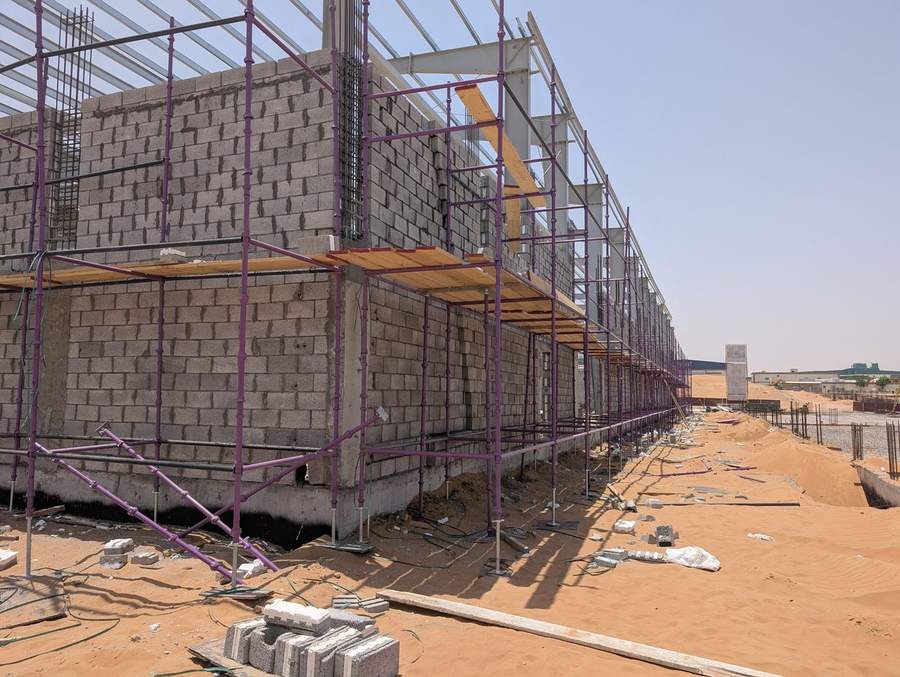
Warehouses, logistics sheds, and industrial buildings are some of the most common large structures going up across the UAE — in the industrial zones of Dubai, the free zones of Sharjah and Ajman, and around the ports and inland depots of the northern emirates. They look simple from the outside, but the access scaffolding that lets crews build, clad, and fit them out is a discipline of its own. This guide covers how warehouse scaffolding works, the main jobs it has to do, and how to plan a cuplock access scaffold for an industrial building in the UAE.
Why Warehouses Need a Different Scaffold
A villa or low-rise building is mostly about supporting concrete slabs — that's shoring and falsework. A steel-frame warehouse is the opposite: the structure is erected by crane, and the scaffold's job is to give people safe access to work around that structure at height. Eaves heights of 8 to 12 metres are routine, and high-bay distribution centres can run well past that. The scaffold has to reach those heights safely, stay stable as a free-standing or tied structure, and often span large clear floor areas without anything to tie back to.
Cuplock suits this work well. The same standards and ledgers used for slab shoring build fast, repetitive access bays; the cup-and-blade node lets up to four members meet at one point without loose fittings; and the system scales cleanly from a single mobile tower to a full birdcage covering an entire bay. For an introduction to the components involved, see our complete cuplock component guide.
The Main Warehouse Scaffolding Jobs
Steel frame erection access. While the portal frames, rafters, and bracing go up, riggers and welders need platforms at the connection points. This is usually handled with independent towers or mobile towers positioned at column and apex connections, moved along as the frame progresses.
Roof, purlin, and sheeting work. Once the frame is up, purlins and roof sheets are installed at the highest point of the building. This needs either a high-level working platform along the eaves or, for larger spans, a birdcage scaffold — a fully boarded grid of standards and ledgers that creates a continuous working deck under the roof. Edge protection and fall arrest become critical here.
Cladding and facade. External wall cladding, flashings, and gutters need a facade access scaffold down the long elevations of the building. For tall, repetitive elevations this is best planned to EN 12811 with a defined load class — exactly what our Access Scaffold Planner is built to lay out.
MEP and fit-out at height. High-level electrical, fire-fighting, HVAC ducting, and lighting all need access under the roof. A birdcage scaffold or a fleet of mobile towers gives the MEP trades a stable platform across the floor plate.
Mezzanines and racking. Many warehouses include a steel mezzanine floor or heavy racking. Installing these often calls for localised towers and, in some cases, light shoring to support mezzanine deck pours.
Birdcage vs Mobile Towers vs Facade Scaffold
Choosing the right approach is the heart of warehouse scaffold planning:
A birdcage scaffold is the standard solution for working on a roof or ceiling over a large area. It's a full grid of cuplock standards at regular centres — commonly around 1.8m × 1.8m — braced in both directions and boarded out at the working level. It gives every trade a continuous, stable deck, but it uses a lot of material and takes time to erect and dismantle, so it makes sense when the whole soffit needs working on.
A mobile tower is the right call for localised, repetitive work — a single connection, a light fitting, a section of ducting — where the crew finishes one spot and rolls to the next. It is far quicker to deploy but only serves one footprint at a time. We compare the rolling-tower options in detail in cuplock mobile towers vs aluminum mobile towers.
A facade access scaffold is the dedicated solution for the external envelope — cladding, gutters, and elevational finishes — running as independent tied or free-standing bays down each wall.
On a real project these are mixed: a birdcage under part of the roof, towers for the steel erection, and a facade run for the cladding, each phased so material moves from one task to the next.
Height, Stability, and Load
The defining challenge of warehouse access is height with little to tie into. A free-standing tower has a height-to-base ratio limit — beyond it, the tower must be tied to the structure or widened at the base — so a tall tower in an open shed often needs outriggers or a wider base. Where the steel frame is available, the scaffold can be tied to columns or rafters at defined intervals; where it isn't yet, free-standing stability governs the design.
Load class matters too. Access scaffolds are designed to a working load class under EN 12811, and the number of boarded lifts that can be loaded at once is part of that design. A birdcage carrying men, tools, and bundles of purlins is a different load case from a single inspection platform. And the capacity of each standard depends on its unsupported lift height and bracing — the taller the lift, the lower the safe load — which we explain in jack extension and load capacity. For anything tall, heavily loaded, or free-standing over a big span, a project-specific engineered design is the safe route, not a rule of thumb.
Safety on UAE Warehouse Sites
Industrial sites attract scrutiny, and scaffolding is one of the first things an inspector looks at. The essentials are full edge protection (guardrails and toe boards) on every working lift, proper access by internal ladders or stair towers rather than climbing the frame, scaff-tags showing inspection status, and a competent person checking the scaffold before first use and at regular intervals. Our scaffolding safety requirements in the UAE and inspection checklist cover the regime in full. The single biggest risk on a warehouse is the open edge of a high-level birdcage or roof platform — fall protection there is not optional.
Planning and Pricing a Warehouse Scaffold
A good takeoff starts from the building geometry: clear height to the working level, the floor area or elevation length to be covered, and the type of work. From there you set the bay grid, the number of lifts, and the bracing and tie pattern, then count standards, ledgers, transoms, boards or steel planks, and access components. Our Access Scaffold Planner produces a materials takeoff and a permit-readiness checklist for facade scaffolds, and the BOQ Builder lets you turn any takeoff into a priced bill you can send straight to us for a quote.
SCAFFWORKS has delivered access scaffolding for large industrial buildings across the UAE, including a 50,000+ SQF warehouse and a 55,000 SQF commercial building in Umm Al Quwain. As an in-house manufacturer of cuplock standards and ledgers, we can supply the volume a warehouse needs quickly, with engineering design for the tall and free-standing cases, and rental packages that flex with the construction programme.
Building a Warehouse in the UAE?
SCAFFWORKS supplies and rents cuplock access scaffolding, birdcage systems, and mobile towers for warehouse and industrial projects across the UAE — with engineering design and factory-direct pricing.
Request a Quote WhatsApp Us