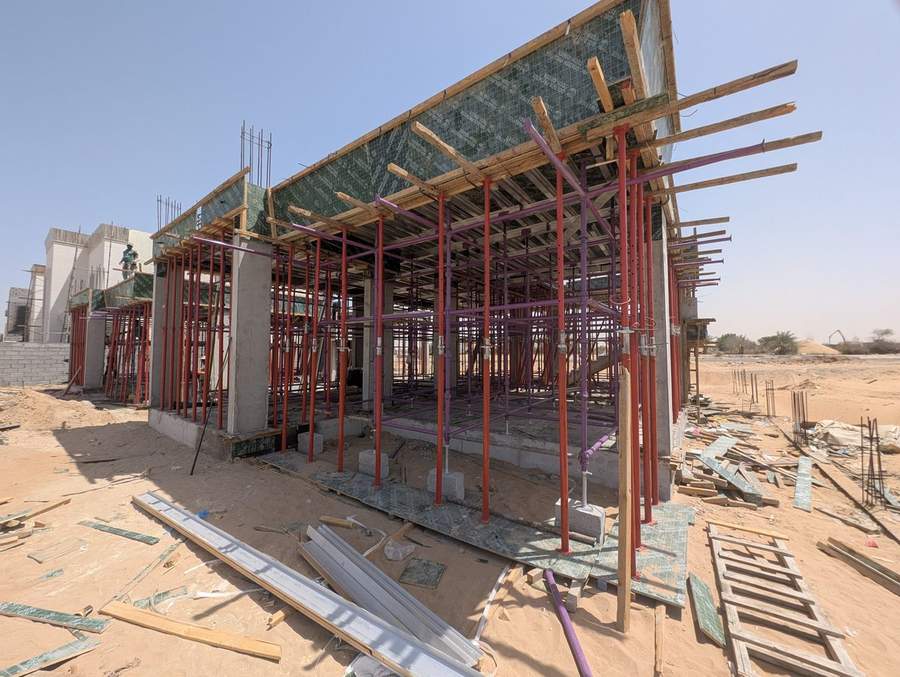
Every cuplock scaffold has adjustable jacks at the top and bottom — base jacks at the ground and U-head jacks (or universal jacks) at the top supporting the formwork beams. These jacks provide the height adjustment needed to accommodate variations in ground level and to reach the exact soffit height. But there's a critical engineering detail that many contractors overlook: the further you extend a jack, the lower the scaffold's load capacity becomes.
Why Extension Reduces Capacity
An adjustable jack is essentially an unbraced steel tube — either a 38mm diameter hollow tube or a 36mm solid bar — with a threaded section for height adjustment. When the jack is fully retracted (minimum extension), the unsupported length is short, and the jack can carry its maximum rated load. As you extend the jack, the unsupported length increases, and the jack becomes more susceptible to buckling under load.
This is basic column theory — the longer the column, the lower the buckling load. And because jacks sit at the very top and bottom of the scaffold, they're the weakest links in the load path. The cuplock standard in the middle is braced by ledgers at regular intervals, giving it a much higher capacity than an unbraced jack extension.
How Much Does Capacity Drop?
The relationship between jack extension and load capacity depends on whether the jack is braced or unbraced. For unbraced jacks — which is the typical condition — the allowable load drops significantly with each 10cm of additional extension.
At 10cm extension, a base jack can carry approximately 45 kN vertically while maintaining its 2.5% horizontal load requirement. At 20cm extension, this drops to around 35 kN. At 30cm, it falls to approximately 25 kN. And at 40cm extension — the maximum typically used — the allowable vertical load is only about 15-18 kN, which is a dramatic reduction from the jack's nominal rating.
U-head adjustable jacks follow a similar pattern. A U-head at 10cm extension can support loads comparable to the base jack at the same extension. But U-heads have the additional complication of being loaded eccentrically — the beam sitting in the U-head may not be perfectly centred, creating a bending moment that further reduces the effective capacity.
The 2.5% Horizontal Load Rule
The design standard BS 5975 specifies a minimum lateral stability criterion — the scaffold must be able to resist horizontal forces equal to at least 2.5% of the vertical load at the point where that load is applied. This horizontal load comes from wind, erection tolerances, non-verticality of the scaffold, and concrete pressure during pouring.
When jacks are extended, their ability to resist this horizontal force decreases rapidly. At full extension, even a small horizontal force can cause the jack to buckle sideways. This is why the allowable load charts for unbraced jacks drop off so steeply — they're accounting for the combined vertical and horizontal loading condition.
When You Must Brace the Jacks
If your design requires jack extensions beyond 20cm — which is common on UAE sites where ground levels vary or where the soffit height doesn't align neatly with standard lengths — the jacks may need to be braced. Bracing a jack means connecting it to the adjacent scaffold structure with tubes and couplers so that the unsupported length is reduced.
A braced base jack at 40cm extension has significantly higher capacity than an unbraced one at the same extension — potentially double the allowable load. The bracing converts the jack from a free-standing column into a restrained member, dramatically improving its buckling resistance.
Universal jacks can also be braced by connecting the jack tube to the adjacent standards using a braced forkhead or braced base plate assembly. These components include a welded tube section that sits inside the jack and connects to the adjacent ledger or standard, providing the lateral restraint needed for higher loads.
Practical Guidance for UAE Sites
Keep jack extensions as short as possible. This sounds obvious, but in practice it means selecting the right combination of standard lengths to minimise the remaining gap that the jacks must fill. Cuplock standards are available in lengths from 0.5m to 3.0m in 0.5m increments, so with the right selection, you should be able to get within 10-20cm of your target height without excessive jack extension.
Never use jack extensions to compensate for poor planning. If the scaffold design calls for a 2.8m leg height and you only have 2.5m and 0.5m standards available, use a 2.5m standard with a short jack extension at the top — don't try to use a 2.0m standard with 80cm of jack extension at the base.
On sloping sites, use the shortest jack extension at each standard position rather than setting all jacks to the same extension. This means adjusting each jack individually to match the ground level at that point, rather than setting up on a level platform and extending all jacks equally.
Always check whether the jack extension used in your scaffold design has been accounted for in the load calculations. If the engineer designed the scaffold assuming 10cm jack extensions and the site crew extends them to 30cm to deal with ground conditions, the scaffold's load capacity may be significantly less than what was calculated.
Different Jack Types Available
The cuplock system offers several jack types to suit different applications. Universal jacks come in 65cm, 76cm, and 86cm lengths and can be used at both the top and bottom of the scaffold via socket base adaptors. Adjustable U-head jacks have a U-shaped head plate for supporting primary beams directly. Fork U-head jacks combine the U-head with a longer fork section for specific beam profiles. Base jacks with flat plates provide ground-level support with or without holes for fixing to the ground.
Hollow jacks (38mm OD, 4mm wall) are lighter and suitable for most applications. Solid jacks (36mm diameter) are heavier but have higher axial capacity, making them more appropriate for heavy-duty shoring applications.
At SCAFFWORKS, we specify the jack type and maximum extension for every scaffold design. Our engineering drawings show the exact standard combination and jack extension at each position, ensuring the scaffold is built to the design capacity — not something the crew has to figure out on site.
Need Scaffolding for Your Project?
SCAFFWORKS manufactures and rents cuplock scaffolding, formwork, and shoring systems across the UAE. Factory-direct pricing, engineering design included.
Request a Quote WhatsApp Us