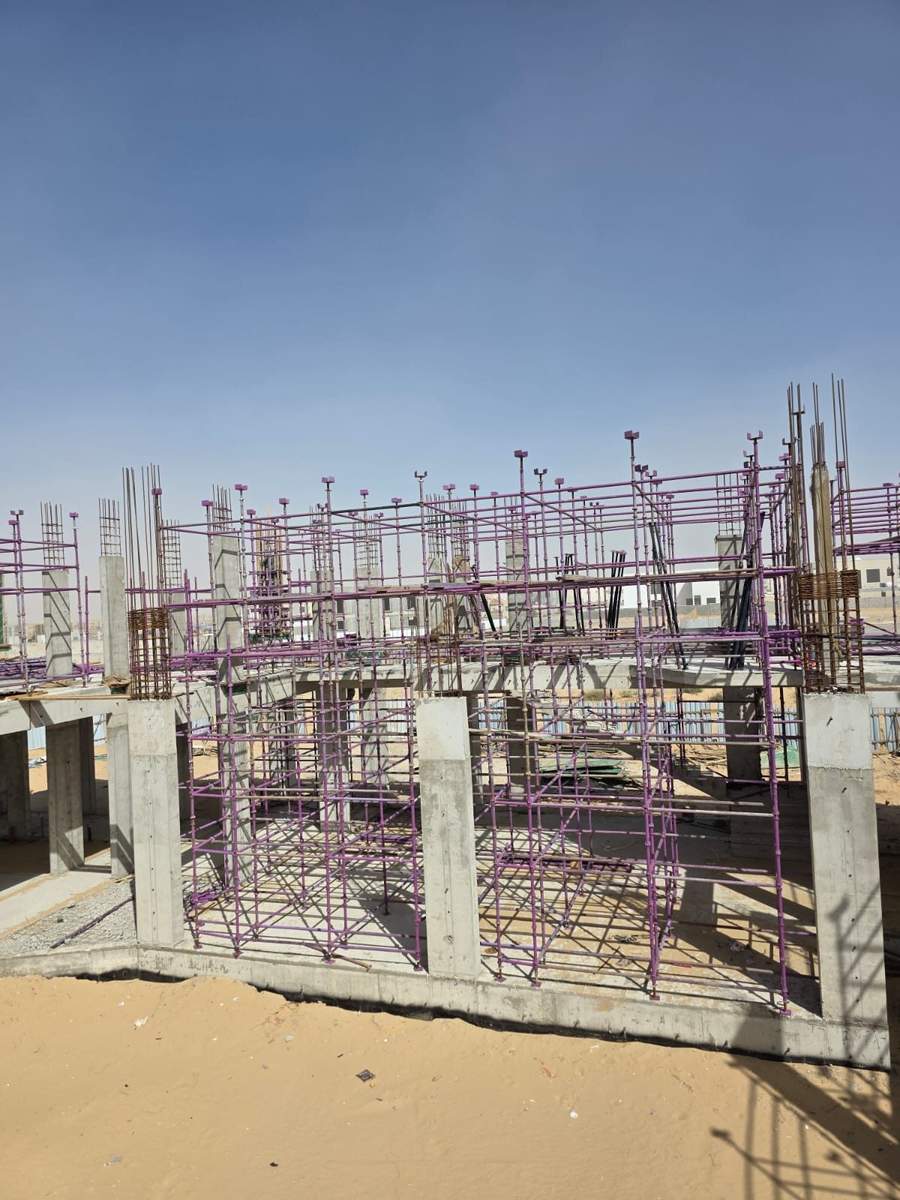
When you use cuplock scaffolding as falsework to support a concrete slab, the most critical question is: can the scaffold safely carry the load? Getting this calculation wrong can result in a collapse during the pour — one of the most dangerous failures on a construction site. This guide walks through the basic shore load calculation so you understand how the numbers work, even if your scaffolding supplier handles the detailed engineering.
What Loads Are We Calculating?
The total load on the scaffolding during a slab pour includes the dead load — the weight of the wet concrete, the reinforcement steel, the formwork (plywood and beams), and the scaffold itself. It also includes the live load — workers, equipment (concrete pumps, vibrators), and the dynamic impact of concrete being placed. Finally, there's a safety factor applied to account for uncertainties.
Concrete Weight
Wet reinforced concrete weighs approximately 25 kN per cubic metre (about 2,500 kg/m³). For a slab, the weight per square metre depends on the thickness. A 200mm slab weighs approximately 5.0 kN/m² (500 kg/m²). A 250mm slab weighs approximately 6.25 kN/m² (625 kg/m²). A 300mm slab weighs approximately 7.5 kN/m² (750 kg/m²).
Formwork Weight
The formwork sitting on top of the scaffold — plywood sheets, secondary beams (timber or aluminum), and primary beams — adds approximately 0.5-1.0 kN/m² depending on the system. For steel decking panels, add closer to 1.5 kN/m² due to the heavier panel weight.
Live Load
The standard design live load for slab formwork is 1.5 kN/m² during the pour. This covers workers, equipment, and the impact of concrete placement. Some engineers use higher values for slabs being placed by pump (up to 2.5 kN/m²) due to the higher impact forces.
Total Design Load
For a typical 200mm villa slab with aluminum beam formwork, the total unfactored load is approximately 5.0 (concrete) + 0.75 (formwork) + 1.5 (live) = 7.25 kN/m². Applying a safety factor of 1.5 gives a design load of approximately 10.9 kN/m².
How This Translates to Grid Spacing
Each cuplock standard supports the load from its tributary area — the area of slab that it's responsible for holding up. On a 1.8m × 1.8m grid, each standard's tributary area is 3.24 m². Multiply by the design load: 3.24 × 10.9 = 35.3 kN (approximately 3.5 tonnes) per standard.
A standard cuplock tube (48.3mm OD, 3.2mm wall thickness, EN10219 steel) has an axial load capacity that depends on its effective length. For a 3.0m standard, the safe working load is typically in the range of 30-45 kN depending on the bracing configuration. So a 1.8m × 1.8m grid works for a 200mm slab with adequate safety margin.
For a heavier 300mm slab, the total design load increases to approximately 13.5 kN/m². On a 1.8m grid, each standard would need to carry 43.7 kN — pushing close to the capacity limit. This is why heavier slabs require a tighter grid — moving to 1.6m × 1.6m reduces the tributary area to 2.56 m² and the load per standard to 34.6 kN, well within capacity.
This article covers the load side — how to arrive at a safe grid. Once you've fixed the grid for your slab, our step-by-step villa scaffolding calculation shows how to turn that grid into actual material quantities (standards, ledgers and accessories) for a takeoff.
Why You Need Engineering
The calculation above is simplified. A proper shore load design considers the actual slab geometry (beams, drop panels, and varying thickness), the capacity of each scaffold component in the load path (standards, ledgers, base plates, U-heads, and the ground bearing capacity), buckling of standards — longer standards have lower capacity, bracing configuration — unbraced or under-braced scaffolds have significantly reduced capacity, and construction sequence — multi-storey buildings require consideration of back-propping loads from floors above.
At SCAFFWORKS, every slab support project includes engineering design — we calculate the loads, determine the grid spacing, and provide a layout drawing specific to your slab. This service is included with our scaffolding supply and rental. If you already have scaffolding from another supplier and need engineering verification, we can provide that too.
Need Scaffolding for Your Project?
SCAFFWORKS manufactures and rents cuplock scaffolding, formwork, and shoring systems across the UAE. Factory-direct pricing.
Request a Quote WhatsApp Us