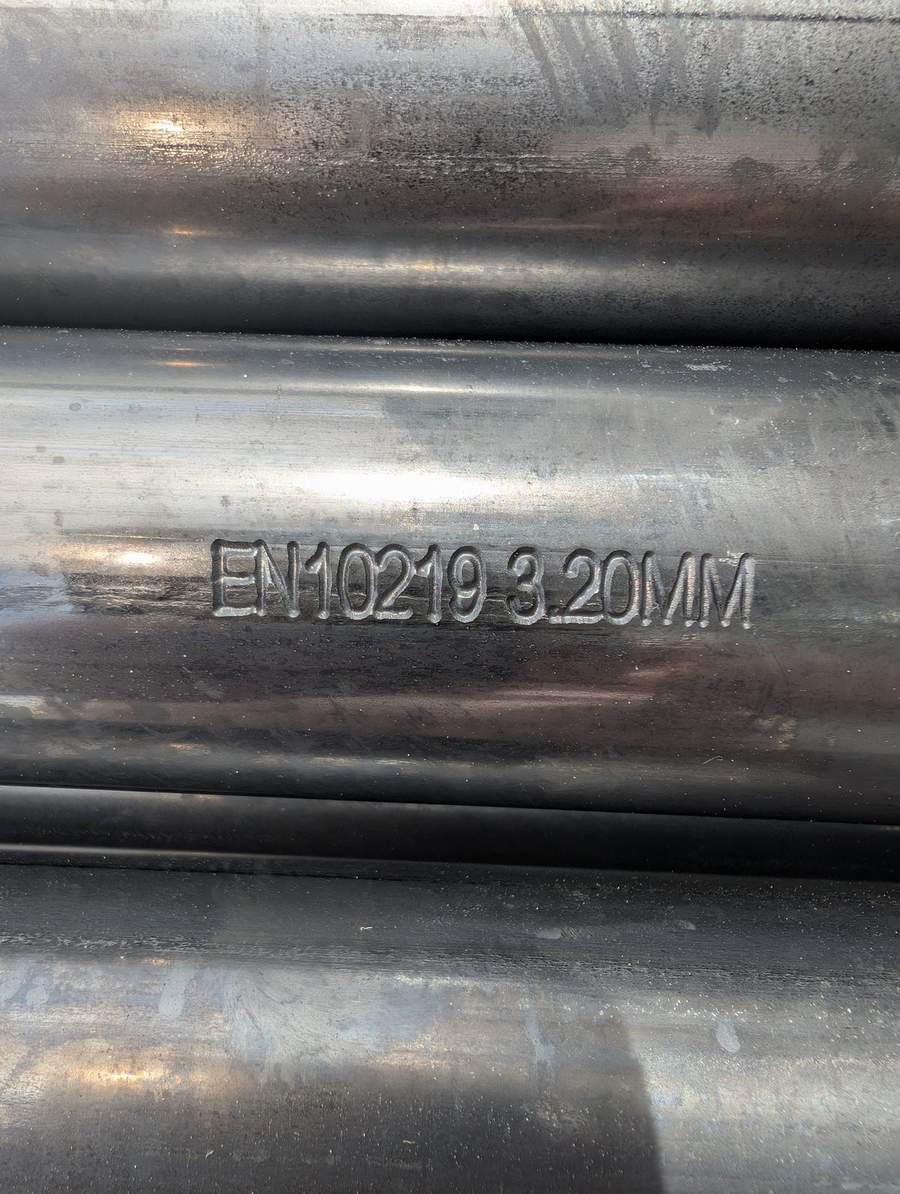
If you've ever looked closely at a scaffolding tube on a UAE construction site, you may have noticed markings stamped into the steel: "EN10219" followed by a wall thickness measurement. This isn't just a manufacturing mark — it's a certification that tells you the steel meets a specific European standard for structural integrity. Understanding what this means can help you make better purchasing decisions and, more importantly, keep your workers safe.
EN10219: The Standard Explained
EN10219 is a European standard (formally EN 10219-1 and EN 10219-2) that governs cold-formed welded structural hollow sections made of non-alloy and fine grain steels. In simple terms, it defines the rules for manufacturing steel tubes that are used in load-bearing applications — like scaffolding.
The standard specifies requirements for the steel's chemical composition, mechanical properties (yield strength, tensile strength, elongation), dimensional tolerances, and testing methods. When a tube is stamped "EN10219," it means the manufacturer has tested and verified that the steel meets all these requirements.
Why Wall Thickness Matters
The number stamped alongside EN10219 — typically 3.20mm or 4.0mm — is the wall thickness of the tube. For scaffolding, this is one of the most critical dimensions because it directly determines how much load the tube can safely carry.
A standard scaffolding tube has an outer diameter (OD) of 48.3mm. The wall thickness determines the cross-sectional area of steel, which determines the axial load capacity. A 48.3mm tube with a 3.20mm wall has significantly more steel (and therefore more load capacity) than one with a 2.5mm wall, even though they look identical from the outside.
This is where problems arise in the UAE market. Some cheaper scaffolding uses tubes with thinner walls — 2.5mm or even 2.0mm — to reduce material costs. These tubes may look the same and fit into the same cuplock system, but they carry substantially less load. Under the weight of a concrete slab pour, the difference can be catastrophic.
How to Verify EN10219 Compliance
Legitimate EN10219-certified tubes will have the marking physically stamped or rolled into the steel surface. This is not a sticker or paint marking — it's embossed into the metal during manufacturing and cannot be easily faked. The marking typically includes the standard number (EN10219), the wall thickness, and often the manufacturer's identification.
You can also request mill certificates (also called mill test certificates or MTCs) from your scaffolding supplier. These are documents from the steel mill that produced the raw tube, certifying the chemical composition and mechanical properties of each batch. A reputable manufacturer should be able to provide these on request.
EN10219 vs BS EN 39 vs Other Standards
You may encounter other standards referenced for scaffolding tubes. BS EN 39 is the British Standard specifically for steel tubes used in scaffolding — it references EN10219 for the base material but adds scaffolding-specific requirements like tube straightness and end squareness. In the UAE market, EN10219 is the most commonly referenced standard for the raw steel tube.
Some scaffolding imported from Asia may reference different standards (like JIS or GB). These aren't necessarily inferior, but they use different testing methods and tolerances. If your project specification calls for EN10219, make sure that's what you're getting — not an "equivalent" from a different standard.
What SCAFFWORKS Uses
At SCAFFWORKS, all our cuplock standards and ledgers are manufactured from EN10219-certified steel tube with a 3.20mm wall thickness and 48.3mm outer diameter. You can see the EN10219 3.20MM stamp on every tube we stock. We source our steel from certified mills and maintain mill certificates for every batch. This ensures that every cuplock standard and ledger that leaves our facility in Umm Al Quwain meets the load-bearing requirements for safe scaffolding on UAE construction sites.
When you buy or rent scaffolding, ask the supplier one simple question: "Can you show me the EN10219 stamp on the tube?" If they can't, or if the wall feels thin compared to what you're used to, it's worth reconsidering the source.
Buy EN10219-Certified Cuplock Scaffolding
SCAFFWORKS manufactures cuplock standards and ledgers from EN10219, 3.20mm wall thickness steel at our UAE facility. Factory-direct pricing with mill certificates available.
Request a Quote WhatsApp Us