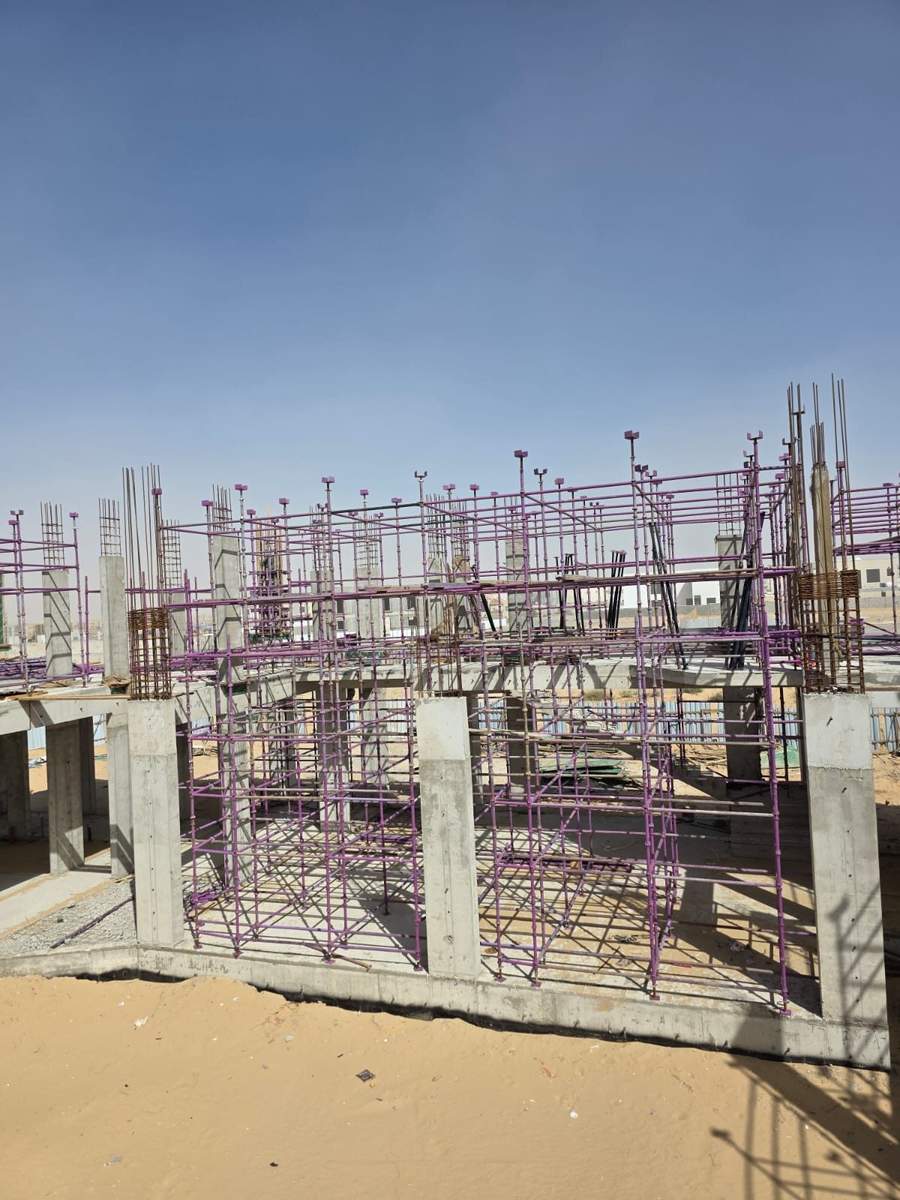
On multi-storey building projects in the UAE, the speed at which you can cycle through floors directly determines your programme timeline and your total scaffolding cost. If you can pour one floor every seven days instead of every fourteen, you cut your construction time — and your rental cost — roughly in half. Early striking is the technique that makes this possible, and the cuplock system with dropheads is specifically designed to support it.
What Is Early Striking?
Early striking is a technique where the formwork — the decking beams, infill beams, and plywood — is removed from the slab soffit 3 to 4 days after pouring, while the supporting scaffold structure of standards, ledgers, and base jacks remains in place undisturbed until the concrete has gained sufficient strength to support itself over its full span.
Concrete typically takes 28 days to reach its full design strength. Most engineers will only permit the complete removal of all support after about 10 to 14 days, depending on ambient temperature and cube strength test results. But the concrete doesn't need its full strength to span the short distances between the remaining support points. Tests and studies confirm that the slab's capacity at 3 days — spanning only the short distances between temporary supports — exceeds its capacity at 10-14 days over the full structural span. This is the principle that makes early striking safe and practical.
How the Drophead Makes It Work
The drophead is the component that makes early striking practical with the cuplock system. It sits on top of the universal jack and supports the primary decking beam. When you strike the drophead wedge, the beam drops approximately 115mm — just enough clearance to slide out the infill beams and remove the decking beams, but not so much that anything falls uncontrolled.
This is a critical safety feature. After striking the wedge, the decking beams and infill beams cannot fall — they must be removed manually by the crew. The concrete soffit is left supported by the universal jacks (still in the raised position), so the slab load continues to transfer down through the cuplock standards to the ground.
The struck decking beams and infill beams are then cleaned, transported, and re-erected on the next floor. Meanwhile, the propping scaffold — standards, ledgers, base jacks, and universal jacks — stays in place supporting the curing slab.
The 7-Day Cycle Explained
An effective cycle depends on the formwork system, labour management, and careful site planning. A typical 7-day cycle runs as follows.
On Tuesday, the crew commences erection of the formwork on the new floor. On Wednesday, formwork erection continues, completing the make-up with infill beams, and steel fixing begins. On Thursday, steel fixing is completed and concrete is poured. Friday, Saturday, and Sunday are curing time — and if you've planned your cycle to align with the weekend, no working days are lost. On Monday, the crew strikes the decking elements using the dropheads, cleans the formwork, and prepares everything for Tuesday when the cycle repeats on the next floor.
If the weekend alignment isn't possible, a cycle time of approximately 9 days can be achieved — roughly 3 cycles in every 4 weeks — allowing a day for initial erection.
How Much Equipment Do You Need?
This is where the economics get interesting. For the 7-day cycle, the ideal equipment ratio is one complete set of decking (beams, infill, plywood) and two complete sets of propping (standards, ledgers, base jacks, universal jacks).
Here's why. A full complement of cuplock propping and decking is used for Floor A. Three to four days after pouring concrete, the decking elements are struck for re-use on Floor B, while the propping remains in place during the rest of the curing period. In practice, supports around columns and close to walls and beams can also be removed — this typically amounts to about one-third of the propping that becomes free for re-use. So you need approximately two-thirds additional propping for Floor B on top of what you've freed up from Floor A.
Three to four days after pouring Floor B, the formwork is removed for use on Floor C. About one-third of the propping from Floor B is removed, along with the total propping from Floor A — which has now been curing for 14 days and can be fully de-propped. This cycle repeats for every subsequent floor.
Concrete Strength During Early Striking
The safety of early striking depends on the concrete gaining sufficient strength in the first 3-4 days to span between the remaining support points. Under typical UAE conditions (ambient temperatures of 25-45°C), concrete curing is actually faster than in temperate climates, which works in favour of early striking.
As a rough guide, concrete reaches approximately 40% of its 28-day strength at 3 days, about 65% at 7 days, and around 85% at 14 days. The punching shear stress at the drophead locations during early striking has been studied and found to be well within safe limits for standard slab thicknesses used in the UAE.
However, early striking should only be carried out with the approval of the project engineer. Cube test results should confirm adequate strength before the decking is removed, and the propping must remain undisturbed for the full curing period.
Erection Procedure
The step-by-step erection procedure for early striking with the cuplock system starts with placing adjustable base jacks at even intervals on the ground. A standard is placed onto a base jack, and two ledgers are placed in its lower cup at a 90-degree angle. The upper cup is placed over the two blade ends but not tightened yet.
A second standard is placed on another base jack, and the previously assembled ledger blade end is fixed into its cup. This is repeated a third time to form a right angle. A fourth standard completes the rectangle with two more ledgers. Four ledgers are added to the top, and the structure is fully tightened.
Diagonal braces are assembled, and universal jacks with dropheads are added on top of the completed supporting grid. Finally, decking beams and infill beams are added and joints are tightened. To install the beams, the drophead is removed from the universal jack at one end and attached to the beam. The finished beam with drophead can then be raised and lowered over the jack.
Dismantling Procedure
Whether the early striking technique is followed or not, the dismantling procedure is the same. The decking beams and infill beams are dismantled by striking the drophead wedge. This striking causes the beams to drop approximately 115mm — enough clearance to slide out the infill beams while keeping everything safely retained.
After striking the wedge, the decking and infill beams are manually removed and taken away. The concrete soffit remains supported and untouched during the curing period. The beams can then be cleaned and re-used on the next floor — you only need another set of supporting components (propping) for the new level.
Complete safety is ensured because the beams cannot fall after striking — they must be physically removed by the crew.
When Early Striking Makes Sense
Early striking delivers the biggest benefit on multi-storey buildings where the same floor plate repeats. With a 7-day cycle, a 10-storey building can have all slabs poured in approximately 10 weeks instead of 20+ weeks with conventional full-curing methods. The rental savings on formwork equipment alone can be substantial.
For single-storey villas or structures with varying floor plates, early striking is less beneficial. The cost of maintaining two sets of propping may not be justified when there's only one or two floors to pour. In these cases, conventional striking after 10-14 days with a single set of equipment is more practical.
At SCAFFWORKS, we supply complete early striking systems including cuplock standards, ledgers, dropheads, universal jacks, decking beams, and infill beams. Our engineering team calculates the propping requirements for your specific project and advises on the optimal cycle time based on your slab design and programme.
Need Scaffolding for Your Project?
SCAFFWORKS manufactures and rents cuplock scaffolding, formwork, and shoring systems across the UAE. Factory-direct pricing, engineering design included.
Request a Quote WhatsApp Us