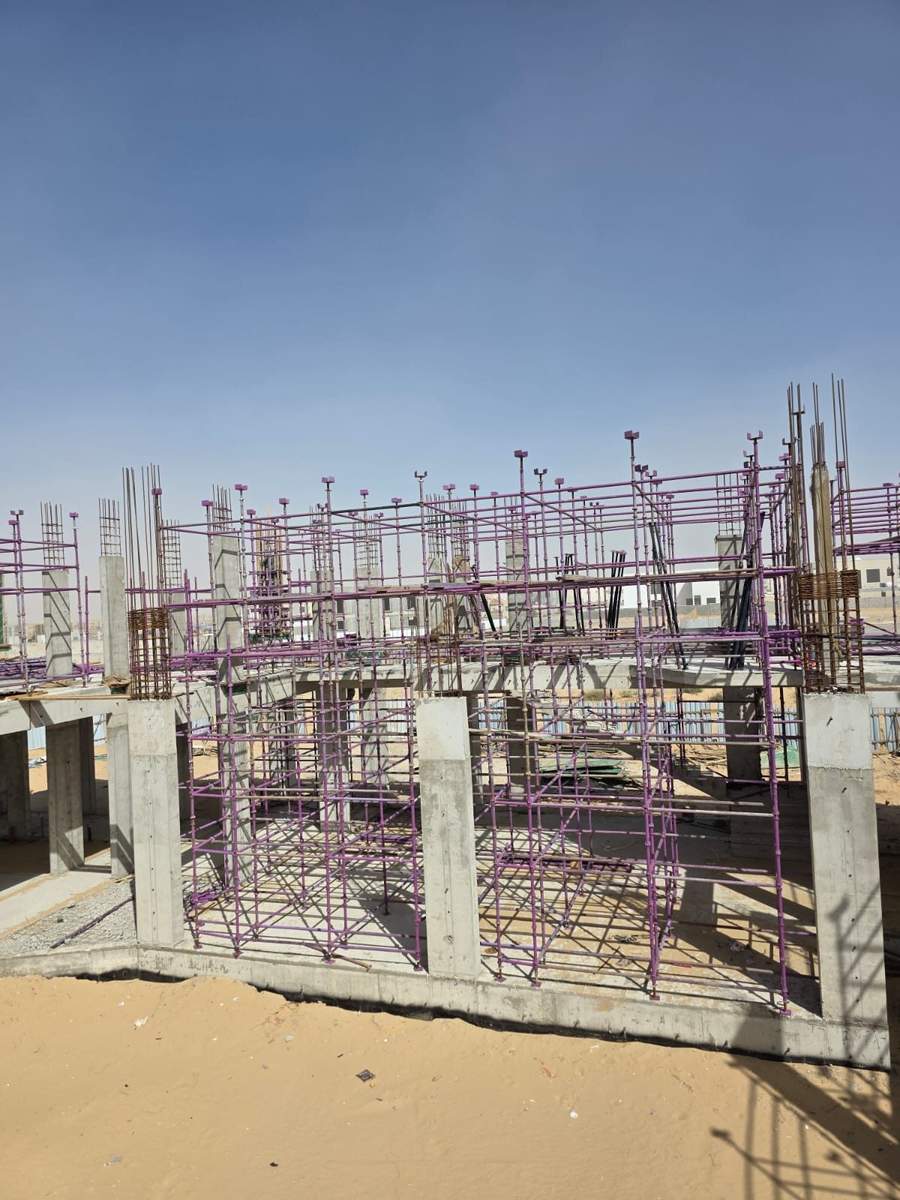
When a contractor in the UAE sets up cuplock scaffolding for a slab pour, the standards and ledgers are only half the equation. What goes on top — the secondary beam system and formwork surface — determines how fast you can set up, how good the concrete finish will be, and how much the whole system costs. The three most common approaches in the UAE market are steel decking panels with plywood infill, Doka-style H20 timber beams with plywood, and aluminum I-beams with plywood. Each has real trade-offs, and the right choice depends on your project.
How Each System Works
Steel Decking Panels with Plywood Infill
This is the most basic and widely used system on UAE villa and small commercial projects. Steel decking panels (sometimes called steel formwork panels or deck panels) span between the cuplock ledgers. They're typically 1.2m or 1.8m long and around 300–400mm wide, made of pressed steel. Where the panels don't cover — around columns, at edges, and where the grid doesn't line up perfectly — you fill in with cut plywood sheets supported by timber or small steel sections. This combination of fixed panels plus cut plywood is what the industry calls "decking and infill."
Doka H20 Timber Beams with Plywood
The Doka H20 beam (and its equivalents from other European manufacturers) is an engineered timber beam with an H-shaped cross section. The top and bottom flanges are solid timber, connected by a plywood web. These beams sit on top of the cuplock U-heads as primary beams, with a second layer of H20 beams running perpendicular as secondary beams. Full plywood sheets then lay across the secondary beams to create the formwork surface. This is the classic European formwork approach and is widely used in the UAE by larger contractors.
Aluminum I-Beams with Plywood
Aluminum I-beams serve the same function as timber H20 beams — they act as primary and secondary beams supporting the plywood formwork surface. The difference is the material: extruded aluminum sections are lighter, don't absorb water, don't warp, and last significantly longer. They sit on the cuplock U-heads the same way as timber beams, with plywood sheets on top.
Speed of Setup
Despite being the simplest concept, steel decking with infill is actually the slowest system to set up. The panels are heavy — significantly heavier than timber or aluminum beams — which makes handling them overhead tiring and slow. You also need the most material: dozens of individual panels plus cut plywood infill pieces, timber supports, and edge boards. The sheer volume of components to position, adjust, and fill around columns and edges adds up. For a 150 sqm villa slab, expect a full day or more with a crew of 4.
Doka H20 timber beams are faster in practice. Although you need to lay out primary beams, secondary beams, and then plywood sheets, the beams are lighter than steel decking panels so the crew moves quicker. You also need fewer total pieces — beams plus full plywood sheets rather than dozens of panels and offcuts. An experienced crew can work through a 150 sqm slab noticeably faster than with heavy decking.
Aluminum I-beams are the fastest to set up. They're the lightest option of the three — roughly 40% lighter than equivalent timber beams and far lighter than steel decking — which makes handling overhead far easier and less fatiguing. The system also requires the least amount of material overall: fewer beams needed due to their superior strength-to-weight ratio, plus full plywood sheets on top. Workers can carry and position aluminum beams quickly, and the weight advantage compounds over a full day of setup.
Concrete Finish Quality
This is where the beam systems have a clear advantage over decking panels. With H20 timber beams or aluminum I-beams, the formwork surface is a continuous plywood sheet. When the plywood is new and properly oiled, the concrete soffit (underside of the slab) comes out smooth and uniform. For projects where the soffit will be exposed or receive a skim coat finish, this matters enormously.
Steel decking panels leave visible lines at every panel joint. The infill sections where plywood meets steel panel create an uneven surface. For projects where the soffit will be covered by a false ceiling, this doesn't matter at all — but for exposed soffits, you'll spend significant time and money on remedial finishing work. On higher-end villas and commercial buildings in Dubai and Abu Dhabi where exposed concrete is part of the design, beam systems are almost always specified.
Between timber and aluminum beams, the concrete finish is essentially the same — both support plywood sheets in the same way. The difference is in how the beams age: timber beams absorb moisture and can warp over time, which eventually causes the plywood to bow and creates imperfections in the soffit. Aluminum beams stay dimensionally stable indefinitely.
Cost Comparison
Steel decking with infill is the cheapest option upfront, typically running AED 13–17 per sqm. The panels are inexpensive and widely available in the UAE. However, you need a lot of material — panels, infill plywood, timber supports for the infill sections — which adds up in transport costs. The sheer weight of steel decking also means higher delivery charges and more trips to site.
Doka H20 timber beams sit in the middle at AED 17–20 per sqm. You need less individual pieces than a decking setup (beams plus plywood sheets rather than dozens of panels plus cut infill), and the beams are lighter to transport than steel decking. The labour saving on soffit finishing often offsets the extra material cost — especially when the alternative is days of grinding and patching panel joint marks.
Aluminum I-beams are the most expensive at AED 22–26 per sqm, but the total system requires the least amount of material. Aluminum beams are the lightest option, meaning fewer truckloads to site and lower transport costs. They also last dramatically longer — a Doka H20 beam might give you 50–80 uses before the web delaminates or the flanges split, while an aluminum beam will last 300+ uses with minimal maintenance. For a rental company or a contractor doing repetitive projects, the lifetime cost per use of aluminum is actually the lowest of all three systems.
Durability in UAE Conditions
The UAE's heat, humidity, and construction site conditions are hard on formwork. Steel decking panels handle it well — they're robust, don't warp, and tolerate rough handling. Their main enemy is corrosion: without regular cleaning and oiling, they rust, which then stains the concrete.
Timber H20 beams suffer in the UAE climate. High temperatures cause the plywood web to dry out and crack. High humidity (especially in coastal areas like Dubai and Abu Dhabi) causes the timber flanges to swell and warp. On a busy site where beams are left out in the sun and occasionally rained on, you can see significant degradation within a single project. Proper storage — stacked flat, under shade, off the ground — extends life significantly, but few UAE sites have the discipline or space for this.
Aluminum I-beams are the clear winner for durability. They don't corrode, don't warp, don't absorb water, and don't degrade in UV. They can be stored outdoors indefinitely. The only maintenance required is checking for physical damage from drops or impacts. In the harsh UAE environment, this durability advantage is hard to overstate.
Which Should You Use?
Use steel decking with infill when the soffit will be covered by a false ceiling, the budget is the top priority, and the project is straightforward. This covers the majority of villa construction and labour camp projects in the UAE. It's the cheapest option and your crew doesn't need specialized training — but expect heavier handling and longer setup times.
Use Doka H20 timber beams when the soffit needs to be smooth (exposed concrete, skim coat finish, or high-end residential), you're doing a single project or a short series, and you want a balance of cost, weight, and quality. This is common on mid-to-high-end villas and commercial buildings across Dubai and the northern emirates.
Use aluminum I-beams when you want the fastest setup, the lightest system to transport and handle, and the best soffit finish with the least maintenance. Aluminum requires the least material overall, has the lowest transport cost, and lasts the longest by far. It's ideal for contractors doing repetitive work (villa communities, multiple buildings) or rental companies looking at total cost of ownership. The higher per-sqm cost pays back quickly on volume.
How It All Sits on Cuplock
Regardless of which formwork system you choose, the scaffolding below is the same: cuplock standards on base plates, ledgers connecting them at the top and intermediate levels, and U-heads on top of the standards to receive the beams or decking panels. The U-head is the interface between the scaffold and the formwork — it allows fine height adjustment (typically 200–400mm of travel) so you can level the formwork surface precisely.
This is one of the advantages of the cuplock system: it's compatible with all three formwork approaches. You can switch from decking panels on one project to aluminum beams on the next without changing any of the scaffolding below. At SCAFFWORKS, we supply the complete system — cuplock scaffolding, U-heads, base plates, and we can advise on the best secondary beam setup for your specific project. Whether you need a basic decking setup for a villa or an aluminum beam solution for a multi-building community, we have the equipment and engineering support to get it right.
Need Formwork Support for Your Slab?
SCAFFWORKS provides cuplock scaffolding, formwork beams, and decking systems for projects across the UAE. Send us your slab drawings and we'll recommend the right setup.
Request a Quote WhatsApp Us