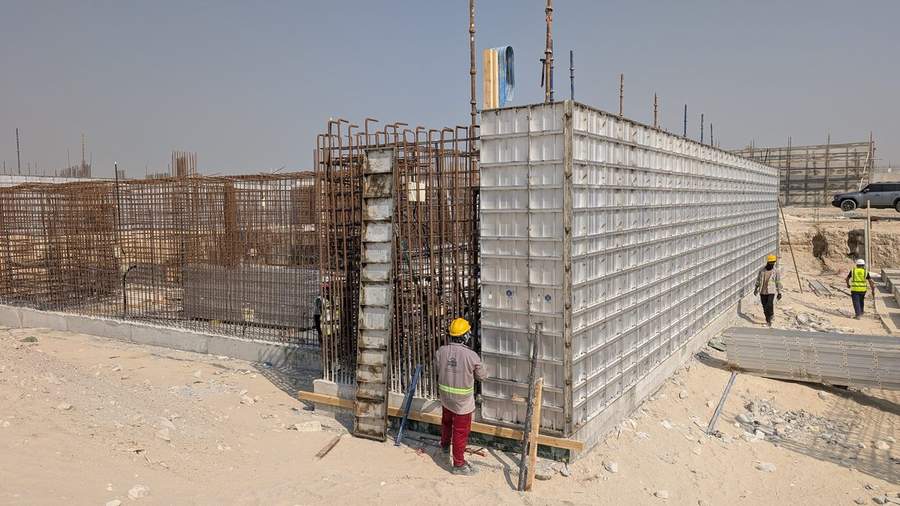
Aluminum formwork has become increasingly popular in the UAE for wall and column construction, particularly on larger residential and commercial projects. The system offers a combination of speed, finish quality, and reusability that traditional timber formwork can't match. This guide covers what you need to know about aluminum formwork for walls and columns in the UAE context.
What Is Aluminum Formwork?
Aluminum formwork consists of pre-engineered aluminum panels that bolt together to create the mold for concrete walls, columns, and slabs. The panels are precision-manufactured with a smooth face that produces a high-quality concrete finish directly from the form — often good enough for direct painting without plastering.
The system typically includes wall panels (various widths from 100mm to 600mm, with heights matching the floor height), column panels (adjustable or fixed for different column sizes), corner pieces, fillers, tie rods to hold opposing panels together against the concrete pressure, and pin-and-wedge connections for assembly.
Why Aluminum Over Timber for Walls?
Traditional timber formwork for walls uses plywood sheets supported by timber walers and soldiers, braced with props. It works, but it has significant drawbacks in the UAE. Timber warps in the heat and humidity, producing walls that aren't straight. Plywood degrades quickly in the UAE climate — you might get 5-8 uses from a plywood sheet before the face deteriorates. And timber formwork requires skilled carpenters to build the wall forms on site, which is time-consuming and inconsistent.
Aluminum formwork solves these problems. The panels don't warp — they maintain dimensional accuracy use after use. A well-maintained aluminum panel can deliver 200+ pours. And the system is designed for assembly by semi-skilled workers following a layout drawing — no carpentry skills required.
When to Use Aluminum Formwork
Aluminum formwork makes economic sense when you have repetitive wall layouts. Villa communities where the same wall configuration repeats across 10, 20, or 50 units are the ideal application — the high upfront cost of the panels is amortized across many uses, and the speed advantage compounds with each repetition.
It also makes sense when the wall finish must be high quality. Exposed concrete walls, fair-face concrete, or walls that will receive direct paint need a smooth, consistent formwork face. Aluminum delivers this naturally.
For one-off or highly irregular wall layouts, timber formwork or a hybrid approach may be more cost-effective because you're not paying for precision-manufactured panels that won't be reused.
Column Formwork
Aluminum column formwork is typically adjustable — a set of four panels with corner connectors that can be configured for different column sizes (typically 200×200mm up to 800×800mm in 50mm increments). The panels are connected with pin-and-wedge systems and braced with push-pull props for alignment.
The advantage over timber column boxes is accuracy and speed. Timber column boxes need to be built to size for each column, while aluminum panels just adjust. For projects with many columns of varying sizes, the time saving is substantial.
Setup Process
Aluminum wall formwork follows a systematic process. First, the wall reinforcement steel is placed. Then the first side of wall panels is erected and aligned using the panel layout drawing. Next, tie rods are inserted through the panel holes and through the wall cavity. The second side of panels is then erected and connected to the tie rods. Push-pull props brace the panels for plumb and alignment. After the concrete is poured and cured, the panels are stripped, cleaned, and oiled for the next use.
For experienced crews, a full floor of wall formwork can be erected in 1-2 days — significantly faster than building timber forms from scratch.
Cost Considerations in the UAE
A full set of aluminum wall formwork for a typical villa floor might cost AED 150,000-300,000 to purchase, depending on the wall layout complexity. This is a substantial investment, which is why rental is the common approach for most UAE contractors.
Rental rates for aluminum formwork are typically calculated per square metre of wall face per month. The rental approach lets you access the system without the capital investment, and the rental company handles maintenance and replacement of damaged panels.
Aluminum Formwork with Cuplock Support
Aluminum wall formwork works alongside cuplock scaffolding on a typical UAE project. The cuplock system handles the slab (as falsework/shoring) while the aluminum panels handle the walls and columns. The two systems are independent but work on the same construction cycle — walls are poured first, then the slab is poured on top of the cuplock falsework.
At SCAFFWORKS, we provide both cuplock scaffolding for slab support and aluminum formwork for walls and columns. Having a single supplier for both systems simplifies logistics, scheduling, and coordination on site. Contact us for a combined quote on your project.
Need Scaffolding for Your Project?
SCAFFWORKS manufactures and rents cuplock scaffolding, formwork, and shoring systems across the UAE. Factory-direct pricing.
Request a Quote WhatsApp Us